

Board Performance · 2025
In this section13 topics
- Prevention of Conflicts of Interest3 items
- Prevention of the Use of Inside Information3 items
- Anti-Corruption5 items
- Whistleblowing3 items
- Selection of Directors & Chief Executives4 items
- Selection of Independent Directors2 items
- Evaluation of Board & Subcommittee Performance3 items
- Subcommittees1 item
- Meeting Attendance & Remuneration3 items
- Supervision of Subsidiaries & Associated Companies3 items
- Board Duty Performance — Overview1 item
- Audit Committee Duty Performance1 item
- Executive Committee Duty Performance1 item
Prevention of Conflicts of Interest
Has the Company Acted to Prevent Conflicts of Interest?
Yes
Operations in the Past Year
Prevention of Conflicts of Interest
The Company has established a policy and practice guidelines on the prevention of conflict of interest based on the principle that any decision on business activities shall be done for the best interests of the Company and shareholders and shall avoid actions that cause conflict of interest to ensure fairness to all stakeholders. The Company, therefore, sets a policy to prevent exploitation of personal interests from being a director, executive or employee of the Company. As a result, the Company has determined practices for directors, executives and employees of the Company therefore, procedures have been established for directors, executives, employees, staff, and related parties, and communicated for their information and compliance as follows:
Practices to prevent conflicts of interest.
1. Avoid conducting related party transactions or connected transactions with oneself or related persons that may cause conflict of interest with the Company, except for transactions that will support medical services and/ or transactions that are reasonable and create benefits to the Company.
2. Refrain from seeking own benefits or benefits of others by using and disclosing information or internal information that has not been disclosed to the public or is confidential to outsiders.
3. Not use documents or information obtained from being the Company’s director, executive or employee in doing his/her own business or other persons’ business that is in competition to or having common characteristics or related to the Company’s business.
4. In case a conflict of interest is found, the matter shall be reported immediately to the supervisor.
The Company has communicated the conflict-of-interest prevention policy to Directors, executives and employees through various communication channels, such as on orientation day, Intranet, and the Company’s documents, and organizes an annual training for review.
In the past year, the internal auditor reviewed the operational process and found that the implementation of the aforementioned persons and departments completely met the policy requirements. In addition, no violations or wrongdoing arising out of a conflict of interest was found.
Number of Conflict-of-Interest Cases
| Metric | Current Year | Previous Year | Two Years Ago |
|---|---|---|---|
| Total number of cases or issues related to conflicts of interest (cases) | 0 | 0 | 0 |
Prevention of the Use of Inside Information
Has the Company Acted to Prevent the Use of Inside Information?
Yes
Operations in the Past Year
Use of inside information for personal benefits
The Company places importance on the supervision of the use of internal information and confidentiality, maintenance of information and confidential documents of customers, and information security in the information technology system. The Company shall not publicly disclose or release confidential information and documents as well as unpublished internal information for own and others’ direct or indirect benefits and with or without returns. The Company’s securities shall not be traded using confidential information and documents or internal information, unless it must be disclosed as required by law. The Company has therefore established a policy on the use of information and confidentiality as guidelines for keeping and preventing the use of internal information that may be significant and may affect the changes in the Company’s stock price as follows:
Practices to prevent the unauthorized use of internal information and maintain confidentiality.
1. Prohibit individuals or units that perceive internal information to disclose such information to unrelated individuals or units unless the Company has already publicly disclosed such information
2. Directors, executive directors, employees and staff members, including advisors to the Chief Executive Officer, who have acknowledged significant internal information which has or may have an effect on the price of the Company’s securities as well as financial information, shall refrain from trading of the Company’s securities during the 30-day silence period prior to the disclosure of financial statements or internal information to the public and during the 24 hours after the Company’s information has been publicly disclosed. Those related to such information shall not disclose that information to other persons, unless such information has been notified to the SET.
3. Doctors, consultants and staff members who play significant roles must sign a non-disclosure agreement to protect the Company’s business information, trade information and confidential information.
The company has provided training on internal information policies and practices to directors, executives, employees, and staff online via the company's e-learning system. Participants were required to sign an agreement acknowledging and complying with the policy. A knowledge test was also administered after the training, with participants required to pass a score meeting the company's criteria. New employees at all levels also received this training during their orientation day.
The Company has disclosed a policy on the prevention of the use of internal information and confidentiality on the Company’s website, www.praram9.com, for all directors, executives and employees to acknowledge and use as practice guideline. The Company has also included the policy in the orientation program for new employees. In the past year, there was no insider trading case.
Number of Inside-Information Cases
| Metric | Current Year | Previous Year | Two Years Ago |
|---|---|---|---|
| Total number of cases or issues related to the use of inside information to seek benefits (cases) | 0 | 0 | 0 |
Anti-Corruption
Has the Company Acted on Anti-Corruption?
Yes
Operations in the Past Year
Anti-Fraud and Corruption Policy
The Company adheres strictly to the transparency, ethics, and good governance, and complies fully to the laws related to anti-fraud and corruption and bribery of government officials or private sector. The Company has created organizational structure that clearly segregates responsibilities, operational processes and line of command to ensure balance of power and appropriate cross-audits. The Company also clearly sets good practice guidelines for Directors, executives and employees in anti-fraud and corruption as follows:
Practices to prevent involvement in corruption and collusion.
1. Prohibit Directors, executives and employees from direct and indirect practices or accept fraud and corruption in all forms. This applies to all related organizations. A regular monitoring and review of the anti-corruption policy is implemented to best address the changing rules, regulations and legal requirements.
2. Directors, executives and employees hold the responsibility to report to the Company on all fraud and corruption related practices by informing their immediate supervisors or responsible persons and shall cooperate in fact finding activities.
3. The Company shall fairly treat and protect whistleblowers who report information about fraud and corruption to the Company as well as those who cooperate with the Company in the fraud and corruption investigation process.
4. The Board of Directors and executives shall act as a role model in fighting against fraud and corruption and encourage and promote anti-fraud and corruption policy by communicating with employees and all related parties, reviewing the appropriateness of related policies and measures to better address the changing business environment, rules, regulations and legal requirements.
5. Those involved with fraud and corruption shall be subject to disciplinary actions in accordance with the regulations set by the Company and may be subject to legal actions if an illegal act is committed.
6. The Company arranges training and disseminates knowledge and information to Directors, executives and employees to ensure their understanding of anti-fraud and corruption policy and to promote ethical practices, integrity, responsibility and their own duties.
7. The Company encourages its counterparties, trade partners and other persons performing duties that are related to the Company’s operations to report on the infringement of the Company’s anti-fraud and corruption policy.
8. The Company has a policy to fairly and adequately nominate and select persons, promote, train, assess performance, and determine remuneration of its employees and contractual staff to prevent fraud and corruption within the organization and provides employees and contractual staff with security.
(More information is presented in “Anti-Fraud and Corruption Policy” in the Corporate Governance, Attachment 5 and on the Company’s website at https://investor.praram9.com/th/company-info/corporate-governance/corporate-governance-policy)
Gift Giving and Receiving Policy
To support and prevent a loophole that may lead to corruption, the Company has clearly determined the gift giving and receiving policy as follows:
Practices regarding the giving and receiving of gifts by the Company.
1. Directors, executives or employees shall not ask for, receive or accept to receive money or other benefits from those with related businesses.
2. Directors, executives or employees may receive or give gifts according to the tradition. The gift shall not worth over 3,000 baht (Three thousand Baht). In case the value exceeds 3,000 Baht (Three Thousand Baht), the person shall report to their immediate supervisor. Accepting gift shall not have impact on any business decision of the receiver.
Fraud and Corruption Risk Assessment
The Company has prepared risk management plan three years in advance and regularly reviews, adjusts the risk management framework every year and clearly identify responsible persons.
The key essence of the Risk Management Plan centers around sustainability, opportunity and performance, and ERM Certify. The Company has clearly set criteria for risk assessment, both likelihood and potential impact, to cover all risks that are not medical treatment related.
Fraud and Corruption Risk Assessment
Fraud and corruption risks arising from business operations and reputation risk are among the six possible risks, such as financial report preparation, loss of assets and corruption. The Company has prepared risk management guidelines as follows:
1. Establishing the Risk Management Committee, comprising Directors and senior executives, to formulate enterprise risk management policy. The Chairman of the Risk Management Committee is a Director/ the Chief Executive Officer, who is the top executive of the Company.
2. Realizing the importance of systematic, efficient and timely risk management, the Risk Management Committee reports directly to the Audit Committee to determine direction, measures, action plan, policy and risk management framework that are in line with the Company’s risk management policy.
3. Monitor, assess and ensure the Company’s risk management is in line with its corporate strategic plan and business direction. It shall also cover policy and scope of the management of the Company’s risks arising from external and internal factors.
In addition, the Company has an internal control and audit system according to the regular annual audit plan. The Internal Audit, which is independent and does not report directly to the management, shall review risks, internal control, corruption and/or related processes and report the results to the Audit Committee and the Board of Directors for consideration respectively.
Internal Audit against Fraud and Corruption
1. The Company has put in place the internal control system to handle corruption related matters, covering the areas of financial, accounting and record keeping, as well as other processes related to anti-fraud and corruption.
2. The internal control system is established to ensure reasonable confidence that the Company’s operations is efficient, reliable and compliant to anti-fraud and corruption related regulations and policy determined by the Company.
Supervision and Control to Prevent and Monitor Fraud and Corruption Risk
The Company has established practice guidelines for supervision and control to prevent and monitor the fraud and corruption risk as follows:
1. Directors and executives are responsible for preventing and detecting fraud and errors by continuously introducing sufficient accounting system and internal control system. Directors and executives at all levels shall perform their duties with honesty, integrity, ethics and morality.
2. The Company will provide risk management that covers the identification and consideration of risks, assessment of the impacts of such risks, consideration on control activities, including monitoring, internal control, and risk response methods covering monitoring of prevention capability, and detecting fraud, errors and failure to comply with laws.
3. Arrange for an internal control system in terms of prevent control and detective control, which is a tool to reduce chances and incentives for misconduct and corruption. The Company has established the criteria for the segregation of duties, such as the segregation of duties between the procurement unit from the finance and accounting unit. In addition, the Company has in place monitoring and assessment processes where the executives will receive reports and acknowledge the causes of the defects or suspicious situations in a timely fashion as well as be able to appropriately improve the preventive control system in assessing internal control. The Internal Audit Department acts as part of the process.
Monitoring and Assessment of Anti-Fraud and Corruption Policy Implementation
The Company has set guidelines for monitoring and assessing the implementation of the anti-fraud and corruption policy as follows:
1. Entrust the Audit Committee to review the accuracy of reference documents and self-assessment form regarding the Company’s anti-corruption measures and approve the Company’s assessment report on corporate governance and corporate social responsibility and anti-fraud and corruption
2. Directors, executives and employees of the Company shall report to the Company on the actions that are considered corruption related to the Company by notifying the supervisor or responsible persons and cooperate in examining the facts.
3. The Board of Directors and executives of the Company shall behave as a role model in anti-corruption to communicate to all employees and related parties and review the policies and measures to ensure they are appropriate and best address the changing business environment, regulations and legal requirements.
4. Directors, executives and related persons shall provide risk management that covers the identification and consideration of risk factors and monitor the process of internal control and risk response, including monitoring the assessment of ability to prevent and detect fraud, error and compliance or non-compliance with the regulations.
The Company ensures communication of such guidelines through various channels such as the Company’s Intranet and website, www.praram9.com, for executives and all employees for acknowledgement and compliance.
Employee Training on Anti-Fraud and Corruption Policy and Guidelines
1. Employee orientation and training programs and seminars during the year.
The Company includes employee training on ethics and practice guidelines in the orientation program. The training content will be reviewed during the year every year and included as part of the corporate governance and social responsibility training courses. Key policies are as follows:
- Anti-fraud and corruption policy and practice guidelines
- Protection of employees who report clues about fraudulent conduct, or failure to comply with laws, regulations and the Company’s Articles of Association.
- Giving or receiving gifts or entertainment
- Prevention of conflicts of interest
- Insider trading
- Protection of the Company’s confidential information
- Internal control and audit system
- Financial and accounting reporting
- Responsibility toward shareholders
- Treatment of executives and employees
- Behaviors of executives and employees
All employees have to complete certain training hours as required by the Company and have to achieve 100 percent score test. In case of failing to pass the test, the Company provides an opportunity for them to study and review their knowledge and understanding before retake the test until they pass. This includes encouraging directors, executives, and employees to participate in anti-corruption training courses organized by external organizations.
2. Communication
The company has communicated to all employees in the organization through various channels, such as the internal computer network system (Intranet), announcements at important points within the company, employee LINE groups in the organization, and has also published to external parties on the company's website at www.praram9.com, Investor Relations section.
Form of Anti-Corruption Operations
| Operation |
|---|
| Review of appropriateness in anti-corruption |
| Review of the completeness and adequacy of the process by the Audit Committee or auditor |
| The monitoring of the evaluation of compliance with the anti- corruption policy |
| Communication and training for employees on anti-corruption policy and guidelines |
| Assessment and identification of corruption risk |
| The participation in anti-corruption projects |
Number of Corruption Cases
| Metric | Current Year | Previous Year | Two Years Ago |
|---|---|---|---|
| Total number of cases or issues related to corruption (cases) | 0 | 0 | 1 |
Details of Corruption Cases
| Status | Period Type | Start of Period | End of Period | Details of the Case or Issue | Investigation Results | Corrective Actions |
|---|---|---|---|---|---|---|
| Incident no longer subject to action | month/year Range | 2023-09 | 2023-10 | In the year 2023, the Company received information regarding an act of misconduct rerate to the misappropriation of Company assets by one employee. The incident was associated with company assets used in the course of duty. The Company took appropriate actions in accordance with internal policies and procedures to address this case of corruption.
Furthermore, the matter was reported to the Audit Committee during the 4/2023 on 8 November 2023 and the Board of Directors Committee during the 6/2023 on 9 November 2023, respectively. However, to prevent such issues from recurring, the Company has communicated with executives channels to raise awareness and ensure understanding of the rules, practices, anti-corruption policies, and penalties. This communication includes regular training foe new employees during the orientation day and periodic reviews conducted annually. | Completed | The Company took appropriate actions in accordance with internal policies and procedures to address this case of corruption |
Whistleblowing
Has the Company Implemented Whistleblowing Procedures?
Yes
Operations in the Past Year
Whistleblowing
The Company has the policy to protect and ensure fair treatment to directors, executives and employees who report the information or provide clues on corruption or non-compliance with the laws, regulations, Articles of Association of the Company as well as the Code of Business Conduct (Whistleblower Policy) which are as follows:
Method of complaint and misconduct report filing
1. The complainant shall directly send complaints or clues of the wrongdoing and fraud in writing to the responsible supervisor (from manager level up). However, in a situation where it is not appropriate or inconvenient, the complainants can report via the Company’s Intranet system, e-mail, comment box or send a letter to the Manager of Quality Department.
2. The supervisor who receives a complaint or clue of wrongdoing and corruption shall notify the Manager of Quality Department without delay or within three working days, to proceed with the investigation process.
3. In the event that the complainant chooses not to disclose the name, the complainant shall clearly specify facts or sufficient evidence to prove that there is a reason to believe that there is fraud or violation of laws, regulations and Articles of Association of the Company or the Code of Business Conduct of the Company.
Fact finding process
1. In conducting an investigation and collecting facts, the complaint recipient shall present the
complaint to the following persons (“Inspector”) for inspection and fact collection related to the complaint.
1.1 In case where the person being complained is an employee in the level lower than
executive, the Deputy Managing Director and/or the persons or units assigned by the Deputy Managing Director to act as the inspector.
1.2 In case where the person being complained is an employee in executive level and
higher, the Audit Committee and/or the persons or units assigned by the audit committee to act as the inspector.
In case where there are inquiries or questions, the inspector can invite any employee or supervisor who is directly responsible for the complainant to provide information or request to send any documents related to the investigation.
2. If the inspection shows that the complaint is true, the Company shall proceed within seven
days as follows:
2.1 In the case of complaints related to fraudulent acts or non-compliance with the laws or regulations, Articles of Association or Code of Business Conduct, the inspector shall consider proposing such complaint along with opinions to the Audit Committee for further consideration
2.2 The inspector shall inform of the progress and results of the investigation on complaint on misconduct and corruption to the complainant who has provided name, address, telephone number, email or other contact information. However, in some cases and for privacy and confidentiality of personal information, the Company may not be able to provide detailed information of the investigation or disciplinary action.
2.3 In case where such complaint is significant, such as the matter that affects the reputation, image or financial position of the Company, conflict with the Company’s business policy or related to high-level executives, the inspector shall consider proposing the said matter with comments to the Board of Directors for further consideration.
2.4 In case where the complaint causes damage to any person, the inspector shall propose appropriate and fair measures to mitigation such damage to the victims under the framework set by the Board of Directors and/or the Audit Committee.
2.5 The Internal Auditor shall find the cause and solutions to the misconduct or wrongdoing in order to prevent reoccurrence and shall report to the Audit Committee for acknowledgement and implementation of the solution.
Safeguarding the whistleblower
1. The complainant can choose not to reveal oneself if he/she feels that the disclosure may cause damage. However, the complainant shall specify clear and sufficient details of facts or evidence proving that there is a reasonable cause to believe of such fraudulent act or violation of laws, rules, regulations and Articles of Association of the Company or Code of Business Conduct. However, if the complainant chooses to reveal oneself, the complaint recipient will be able to proceed faster.
2. The Company considered the information related to the complaint as confidential and will disclose only as necessary considering safety and damage of the whistleblower, source of information or the related persons. The person responsible in all procedures shall keep the information at the highest level of confidentiality and shall not disclose it to others. Violation of such practice will be considered a violation of discipline.
3. In case where the whistleblower considers that he/she may be insecure or troubled or damaged, the complainant can request the Company to provide appropriate protection measures or the Company may establish protection measures without receiving request by the whistleblower if it considers that the matter is likely to cause damage or insecurity.
4. Employees who treat other people with unfair manner, discrimination or cause damage to other persons who report or complain or provide clues on corruption or non-compliance with laws, rules, regulations business ethics of the Company, or file a lawsuit or bear witness or give statements or cooperation to the court government organizations, the employees shall be considered performing and offense of discipline and shall be punished. Such persons may be punished as specified by law if the persons commit offense under the law.
5. Those who have suffered or damaged will be compensated through appropriate and fair methods and process considered by the Quality Department.
In addition, external stakeholders can ask for information, report complaints or clues of illegal acts, inaccuracy of financial reports, defective internal control system or violation of the Company’s Code of Business Conduct or violation of rights through the complaint channels as follows :
1. By mail : The Audit Committee Rama 9 Hospital Public Company Limited No. 99Rama IX Road, Bangkapi, Huai Khwang, Bangkok 10310 2. By phone: 1270 3. The Company’s Website, www.praram9.com, under the Investor Relations Section, on the Whistleblowing Page. 4. The Company’s Website, www.praram9.com, on the Contact Us Page for submitting suggestions, feedbacks, questions or complaints 5. Public Relations Signage by scanning the QR Code on the signage to submit suggestions, feedbacks, questions or complaints. |
The information, complaints and clues of misconduct that are reported to the Company will be kept confidential. The Audit Committee shall command for the inspection of information to find solutions and shall further report to the Board of Directors.
Protection of Directors, Executives and Employees
1. The Company assures Directors, executives and employees that they will not be demoted, punished or affected when they refuse to take bribery even though such action causes the Company to lose business opportunity. The Company believes that the anti-corruption and bribery policy and practices would create long-term value for the Company.
The Company does not allow anyone to threaten, harass or detain Directors, executives and
employees who are committed to anti-corruption policy
2. In case a Director, executive or employee believes he/she is threatened, harassed or detained, the person should immediately report the clue or file a complaint to the supervisor or the Human Resource Department. If the case is not being attended properly, the person shall report through the Company’s reporting channels.
Cooperation to adopt the Company’s anti-fraud and corruption policy and measures
The company recognizes the importance of conducting business transparently and honestly, and opposes processes that lead to fraud and corruption. In addition to campaigning and encouraging employees to cooperate against fraud and corruption, the company has sent letters requesting cooperation from customers, business partners, individuals, and/or related entities listed in the register of key customers doing business with the company, to cooperate in combating fraud and corruption according to the company's guidelines publicly disclosed internally and externally on the website www.praram9.com under the Company Information section, Corporate Governance category. Several individuals have expressed their willingness to join the company in the fight against corruption and have submitted written confirmations of their support and adherence to the company's anti-corruption policies and measures.
This year, 2025, marks a significant advancement for the company in this area. In addition to business partners expressing their willingness to join the company in the fight against corruption, two other business partners have declared their intention to join the Thai private sector anti-corruption coalition with the company. The company anticipates further positive developments in the future.
Furthermore, anyone who witnesses fraud or corruption within the company can report the information, file a complaint, or provide a tip-off about the wrongdoing to the company via mail addressed to the Audit Committee, by telephone, or through the company website. The contact details are the same as those used for complaints from external stakeholders.
Monitoring and handling procedures when receiving information, complaints, or reports of wrongdoing
In 2025, the Company did not receive any information about any wrongdoings resulting from corruption. The Risk Management Manager has summarized the report to the Audit Committee meeting every quarter.
However, the Company has communicated to executives and employees to be aware of the regulations, practices, including the anti-corruption policy and penalties, in addition to training new employees on the employee orientation day and reviewing it regularly every year.
Number of Whistleblowing Cases
| Metric | Current Year | Previous Year | Two Years Ago |
|---|---|---|---|
| Total number of cases or issues received through whistleblowing channels (cases) | 0 | 0 | 0 |
Selection of Directors & Chief Executives
Are Directors Selected Through the Nomination Committee?
Yes
Are Chief Executives Selected Through the Nomination Committee?
Yes
Rights of Minority Shareholders on Director Appointment
The Company has a policy to allow shareholders to propose additional agenda and nominate qualified persons to be elected as the Company’s directors at the Annual General Shareholders’ Meeting. This includes the opportunity for shareholders to submit questions on the Company or about the agenda in order to inquire on doubtful issues to the Company in advance, prior to the Company’s Annual General Shareholders’ Meeting. The Company has published details and criteria for granting such right on the Company’s website at www.praram9.com under the Investor Relations section and on the SET’s website for acknowledgement of shareholders and investors. Details are as follows:
Proving the shareholders with the right to propose additional agenda, nominate qualified persons to be elected as directors, and submit questions prior to 2025 Annual General Meeting of Shareholders | ||
Meeting date 25 April 2025 (via electronic means) | Providing the right to propose additional meeting agenda and nominate person to be elected as director 1 October 2024 - 31 December 2024 | Providing the right to submit questions prior to the meeting 1 October 2024 – 31 March 2025 |
Note: No shareholders proposed additional agenda items, nominated individuals for election as directors, or submitted advance questions.
A for the 2026 Annual General Meeting of Shareholders, the Company provided shareholders with the opportunity to propose additional agenda and nominate qualified persons to be elected as the Company’s directors in advance, starting from 1 October 2025 to 31 December 2025. Shareholders can submit questions about the Company prior to the meeting from 1 October 2025 to 31 March 2026.
Voting, vote counting, and vote counting method in each agenda: The Company provided ballots for every agenda. On the agenda concerning the appointment of Directors, the Company provided shareholders with an opportunity to vote for each individual nominated candidates for the appointment of Directors by using advanced technology for shareholders’ convenience, and for faster and more accurate vote counting in order to enable the Company to present the vote counting results to the shareholders for prompt acknowledgement as follows:
(1) In case of physical meeting, barcode system will be adopted;
(2) In case of e-Shareholder Meeting, e-Proxy system will be adopted.
In 2025, the Company conducted an e-Shareholder Meeting, however the shareholders were able to vote for each individual nominated candidate for the appointment of Directors. In order to comply with the relevant laws and the Company’s Articles of Association
Method of Director Appointment
| Method |
|---|
| Method whereby each director requires approval votes more than half of the votes of attending shareholders with voting rights |
Selection of Independent Directors
Criteria for Selecting Independent Directors
Independent Director
Of the total number of members of the Board of Directors, at least one third or no less than three persons must be independent directors, according to the Company’s Good Corporate Governance and Business Code of Conduct Handbook. All independent directors shall be knowledgeable, competent and qualified as prescribed by the laws, by being able to independently express opinions in the meeting, regularly attend the meetings and have adequate access to other financial and business information to be able to express opinions independently, maintain the benefits of related persons and prevent conflicts of interest between the Company and directors, executives or majority shareholders or other companies that have the same group of directors, executives or majority shareholders. Moreover, independent directors shall report their independence once appointed and on yearly basis, which will be disclosed in the Annual Report and notified to the Company for acknowledgement of changes.
The Company has established the following qualifications of independent director:
(1) Holding no more than one percent of total voting shares of the Company, its parent company, subsidiaries, associated company, major shareholders or controlling persons, inclusive of the shares held by related persons of such independent director.
(2) Not being or used to be an executive director, employee, staff, advisor with regular salary, or controlling person of the Company, its parent company, subsidiary, associated company, subsidiary of the same level, major shareholder or controlling person unless the person has retired from having such characteristics for at least two years prior to the appointment as independent director. Such prohibited characteristics, however, do not include the case that the independent director used to be a government official or advisor of a government agency which is a major shareholder or controlling person of the Company.
(3) Not being related, whether by blood or legal registration as father, mother, spouse, sibling and child, including spouse of the offspring of other directors, executives, major shareholders, controlling parties, or persons who will be nominated as directors, executives, or controlling parties of the Company or subsidiary.
(4) Not having or never had any relationship with the Company, its parent company, subsidiary, associated company, major shareholder or controlling person, in the manner that may prevent the person to have independent judgement. The person should not currently be or never be a significant shareholder or controlling person of any person having a business relationship with the Company, its parent company, subsidiary, associated company, major shareholder or controlling person, unless the person has retired from having such characteristics at least two years before the appointment as an independent director.
(5) Not being or having never been the auditor of the Company, its parent company, subsidiary, associated company, major shareholder or controlling person and not being a significant shareholder, controlling person, or partner of an audit firm which employs auditors of the Company, its parent company, subsidiary, associated company, major shareholder or controlling person; unless the person has retired from having such characteristics at least two years before appointment as an independent director.
(6) Not providing or having never provided professional services, legal consulting, nor financial consulting services and received fees exceeding two million Baht per year from the Company, its parent company, subsidiary, associated company, major shareholder or controlling person, and not being a significant shareholder, controlling person or partners of the such services providers unless the person has retired from having such characteristics at least two years before appointment as an independent director.
(7) Not being a director appointed as a proxy of the Company’s director, major shareholder, or a shareholder with relationship with a major shareholder
(8) Not undertaking any business of the same nature and in competition with the business of the Company or the Company’s subsidiary, or not being a significant partner in a partnership nor an executive director, employee, staff, advisor with regular salary or holding shares exceeding one percent of the total number of shares with voting rights of another company which operates a business of the same nature and in competition with the Company or its subsidiary
(9) Not possessing any other characteristics that prevent the ability to independently express opinions on the Company’s business operations.
Recruitment and Appointment of Directors, Board Executives, and Senior Management
Criteria for Considering the Appointment of Directors, Board Executives, and Senior Management
(1) The Nomination and Remuneration Committee is responsible for considering and nominating directors, sub-committee, and the Company’s Chief Executive Officer, who have complete qualifications and meet with the Company’s director qualification guidelines (More details of the qualifications of directors and the Chief Executive Officer are presented under the “Management Structure” Section, “Qualifications of Directors, Independent Directors and the Chief Executive Officer”), and have the knowledge, capabilities, and experience that support the business strategy. The nominee shall be able to contribute sufficient time to perform the duties as a director, and has necessary skills currently lacked in the Board Skill Matrix. The committee will then carry out the director and executive appointment process.
(2) In case a shareholder nominates a person with appropriate qualifications as a director and/or the Chief Executive Officer, the Nomination and Remuneration Committee shall consider the qualifications of the nominated person according to the Company’s criteria and continue the director and senior executive appointment process.
The Company places importance on Board diversity for effective, flexible, and beneficial management which can lead the Company to achieve the main objectives and goals. For this reason, the Company has established the policy on the diversity of structure of Board of Directors as follows.
(1) The structure of the Company’s Board of Directors is consistent with the Company’s Articles of Association which prescribes that the Board of Directors shall have not less than five (5) persons. Not less than half of the total number of directors shall have residence in Thailand and shall have all the qualifications required by the Company’s Charter as well as shall not be a person with prohibited qualifications as required by law. The shareholders will consider the appointment of the Company’s directors
(2) The number of independent directors shall be no less than one third of the total number of the directors and shall not be less than three (3) persons, including at least two (2) female independent director to provide opportunities and increase the role of knowledgeable and capable women to demonstrate and bring out their capabilities and experience to develop the organization.
At present, there are One female directors, representing 10 percent of the total 10-member Board of Directors. Having female directors sitting in the Board will add diverse and sensitive opinions that provides more balanced opinions in any consideration and discussion.
In the future, if the Company increases the number of directors, the Company has a policy to provide equal opportunity for new male and female directors and fully support any additional female independent directors. (3) The Board of Directors shall consist of persons with knowledge, capabilities and skills and a variety of expertise (Board Diversity), performing their duties in an ethical manner and with integrity, and having experience related to the Company’s business that supports the performance of their duties to enable the composition of the Board of Directors to be in accordance with the Company’s short-term and long-term business strategies, regardless of gender, age, race, religion, educational background, knowledge and professional skills.
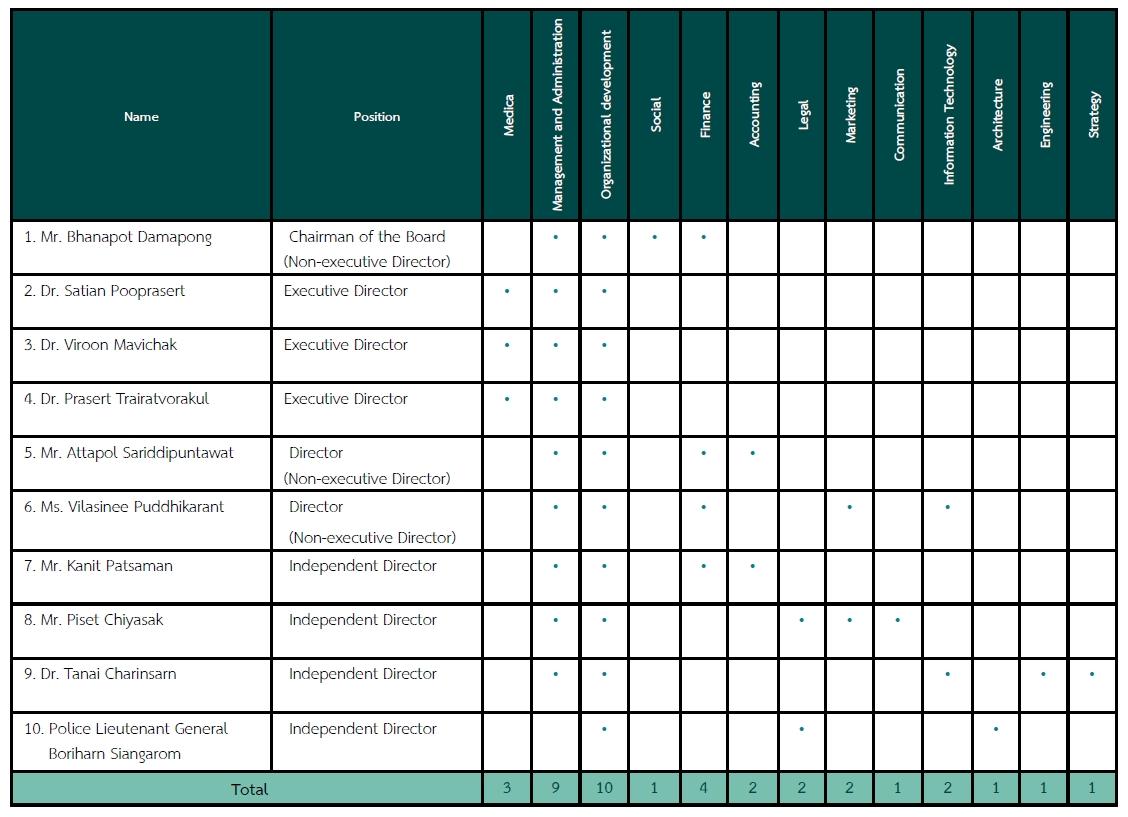
In the recruitment and appointment of the board, the Company considers diversity in the board structure (Board Diversity) in various aspects as appropriate. The composition of the board (please refer to Section 7.2 for details on board composition, Section 7.2.1 Board of Directors) and details of knowledge, expertise, and specialization (Board Skill Matrix)
(4) The Chairman of the Board of Directors is not an individual who is also an executive director and is not a member of any sub-committees to ensure that sub-committees can express their opinions independently.
(5) The Board of Directors consists of 3 directors with experience in the medical field, consisting of 3 executive directors, accounting for 30 percent of the total Board of Directors.
(6) The Board of Directors has a tenure of not more than three years in accordance with the specified laws. The Board of Directors has established the policy specifying that the tenure of an independent director shall not exceed nine consecutive years from the first day of appointment as independent director and without any exemption.
(7) To ensure the Company’s proper and smooth management, the Company has appointed a Vice- Chairman of the Board of Directors to perform the duty in case where the Chairman of the Board of Directors is not able to attend a meeting. The Board of Directors resolved to appoint Dr. Satian Pooprasert to be a Vice-Chairman of the Board of Directors.
The process for recruiting and appointing directors, executive directors, and senior executives.
(1) In the nomination and appointment of directors and the Company’s the Chief Executive Officer is partly based on Professional Search Firm or the Director Pool to create diversity in the structure of the Board of Directors.
(2) Prepare Board Skill Matrix to determine the qualifications of directors that the Company wants to recruit, by considering the necessary skills the Board of Directors still lacks of and work experience that is in alignment with the Company’s business strategy.
(3) In case where the Nomination and Remuneration Committee considers that the Company still lacks of the directors or executives who have specific knowledge, competency or specific experience, the Nomination and Remuneration Committee will consider recruiting persons for additional positions to comprehensively help develop work potentials in various aspects of the Company.
(4) Once the Nomination and Remuneration Committee has nominated qualified persons, the Committee will propose the new directors and senior executives to the Board of Directors Meeting for consideration and/or proposing to the Shareholders’ Meeting for approval, as the case may be.
(5) In case of the appointment of directors to replace the vacant positions for reasons other than rotation of office, the Nomination and Remuneration Committee shall select persons who are fully qualified in accordance with the determined criteria to propose to the Board of Directors Meeting to appoint a replacement position in the next Board of Directors Meeting unless the term of the director is less than two months. The person who is appointed to the position in such case shall remain in the position for only the remaining term of the vacating director
Succession planning for top executive positions (executive directors) and senior management
The Company has a plan to appropriately and transparently select personnel that will be responsible for significant management positions at all levels to ensure that the Company has professional executives. The Board of Directors has required a succession plan be prepared for the Chief Executive Officer and senior executives. In the event that the Chief Executive Officer or a senior executive retires, resigns or is unable to perform one’s duties. For the Company’s continuity of management, the Nomination and Remuneration Committee (“Nomination Committee”) has been entrusted to oversee the succession plan and intermittently report to the Board of Directors for acknowledgement at least once a year.
In case the position of the Chief Executive Officer or senior executives is vacant or the person in the position cannot perform one’s duties, the Company has an initial action plan as follows:
1. Chief Executive Officer
When the Chief Executive Officer position becomes vacant or the person in the position cannot perform one’s duties, the Company will assign an executive at a similar level or the Deputy Managing Director level to hold the position until the recruitment and selection of persons with qualifications in accordance to the criteria set by the Company. (More details of the criteria for the appointment are presented in the Section of the “Nomination and Appointment of Directors and Executives”.)
2. Senior Executives
When the senior executive positions, ranging from the Assistant Director level up to the Deputy Managing Director level or those who are in such positions, are not able to perform their duties, the Company will propose a successor selected by the Deputy Managing Director, the Human Resources Management Department (In case that the vacant position is the Deputy Managing Director, the Human Resources Management Department, it shall be the duty of the Chief Executive Officer) and propose to the Chief Executive Officer for consideration and approval of the appointment.
In 2022, the Board of Directors No. 5/2022 dated 5 July 2022 considered and approved the appointment of the Screening Committee for the Selection of the Executives Holding the positions of Chief Executive Officer and Deputy Managing Director and the amendments to the name list of members of the Screening Committee for the Selection of the Executives Holding the positions of Chief Executive Officer and Deputy Managing Director at the Board of Directors’ Meeting No. 7/2022 dated 10 November 2022. The scope of authority of the Sub-Committee is as follows:
- Participate in the succession planning process and/or provide its opinions with regard to the required qualifications of successors.
- Support and/or provide the information of the executives or nominated successors.
- Provide recommendations and assist in preparing the potential successors and developing their skills.
Development of the Board of Directors, Executives, and Company Secretary
The Board of Directors has established a policy to promote and enhance the knowledge and skills of its directors, executives, and company secretary. This involves active participation in determining the structure and development plans for the Board of Directors, subcommittees, executives, and the Company secretary. The objective is to continuously enhance the necessary competencies required for fulfilling their duties and responsibilities on an annual basis. This development may be conducted through internal training programs organized by the Company or external courses provided by recognized institutions, organizations, or regulatory bodies.
Notably, 100% of the Company’s directors have successfully completed training programs specifically designed for board members, as detailed in Appendix 1: "Board of Directors’ Profiles. "Additionally", in 2025, the Board of Directors, the top four executives, and the Company secretary have participated in training programs and seminars relevant to the Company's business, corporate governance, sustainable business development, and other courses that support their roles and responsibilities. These training programs were attended in both internal formats, conducted at the Company’s premises, and external formats, hosted by professional institutions. Details can be found under the heading regarding board member development.
The Company has disclosed all training and seminar information for the top 4 executives and the Company secretary in the attached document under the section 'Board Profile - Information on Board Directors, Executives, and Company Secretary.
Orientation program for Directors and employees
The Company has a policy to arrange orientation program for Directors, executives and employees. The objective is to present information about the Company and its business, such as vision, mission, operational plan, strategies, future growth targets, nature of business, organizational structure, roles, and responsibilities, and various criteria to ensure compliance with laws and regulatory requirements. These criteria include principles of good corporate governance, business ethics, key policies, and practices, such as the anti-corruption policy, conflict of interest prevention, fair competition, and the responsible use of internal information. Additionally, it covers the Company's rules and regulations, including working procedures and employee benefits. This orientation aims to prepare individuals for their roles, and the Human Resources department and relevant units are responsible for presenting the details to support effective job performance.
After the training, the Company holds a post-training test to assess the participants’ knowledge and understanding. All the participants must pass a test on corporate governance compliance and the Code of Conduct and earn an achievement level score determined by the Company, representing 100 percent achievement.
Such course is compulsory for new employees who have to attend this course on a yearly basis and all are required to pass a test, representing 100 percent achievement.
Did Any Independent Director Have a Business or Professional Relationship?
No
Evaluation of Board & Subcommittee Performance
Criteria for Evaluating Board Performance
Performance Assessment of the Board of Directors and Sub-Committees
To ensure that the governance, control and management fully comply with the corporate Governance principles and to monitor and assess the result against the objectives and goals, the Company set a policy for the Board of Directors, Sub-Committees and the Chief Executive Officer to take the performance appraisal at least once a year. The assessment results will provide the Board of Directors, Sub-Committees and the Chief Executive Officer with significant information and opportunity to review their performance, issues and problems in the past year. This will enhance the effectiveness of the performance of the Board of Directors, Sub-Committees and the Chief Executive Officer with the assessment process and criteria as follows:
The Company organizes performance appraisal of the Board of Directors and Sub-Committees on a yearly basis. The appraisal covers three areas as follows:
(1) Self-assessment of the Board of Directors and Sub-Committees
(2) Individual self-assessment of the Board of Directors and Sub-Committees
(3) Individual assessment of the Board of Directors (assessing other members)
Operating Performance Assessment Process
(1) The Nomination and Remuneration Committee considers and set policy and scoring criteria of each key item based on the assessment form.
(2) The Company Secretary Office will submit the performance assessment form to all Directors for both group and individual assessment.
(3) The Board of Directors sends back the form to the Company Secretary Office who collects and summarizes the assessment results, and reports to the Nomination and Remuneration Committee and the Board of Directors in the first Board of Directors’ Meeting of the year. Moreover, for various recommendations received from the performance evaluation of the Company's board and sub-committees, the Company will adjust enhance the effectiveness of the board and sub-committees, aiming to maximize the benefits in conducting business and overseeing the Company's operations in the future.
Scoring Criteria and Assessment Summary
Score (%) | Level |
85 - 100 | Excellence |
75 - 84 | Very Good |
65 - 74 | Good |
50 - 64 | Fair |
Below 50 | Need Urgent Improvement |
Chief Executive Officer Performance Appraisal
The Company conducts performance appraisal for the Chief Executive Officer once a year. The Nomination and Remuneration Committee submits the results to the Board of Directors within the first month of the year. The appraisal shall cover the following key areas:
1. Vision and leadership in order to become a sustainability organization
2. Appropriately set and plan corporate strategies
3. Ensure the company achieves its mission and strategic plan by integrating sustainability issues into its business operations for sustainable growth.
4. Monitor, supervise and control operational performance to comply with the laws and corporate governance principles
5. Efficiently plan and manage financial transactions
6. Nurture good relationship with stakeholders, build corporate value and reputation in the eyes of outsiders, such as surrounding communities and the general public
7. Encourage business operations with responsibility towards the society and the environment
8. Manage and create good corporate culture as well as supports and take good care of employees
9. Regularly develop new products and services
Operating Performance Appraisal Process
1. The Nomination and Remuneration Committee considers and determines the policy and scoring criteria for key items according to the assessment form, and jointly assesses the performance of the Chief Executive Officer.
2. The Nomination and Remuneration Committee reports the assessment results to the Board of Directors.
Scoring Criteria and Assessment Summary
Score (%) | Level |
85 - 100 | Excellence |
75 - 84 | Very Good |
65 - 74 | Good |
50 - 64 | Fair |
Below 50 | Need Urgent Improvement |
The performance assessment results of the Chief Executive Officer in 2025 are as follows
Assessment | Score (%) | ||||
2021 | 2022 | 2023 | 2024 | 2025 | |
Performance assessment of the Chief Executive Officer | 99 | 99 | 97 | 99 | 100 |
Evaluation of Board Performance in the Past Year
The Board of Directors’ performance assessment results are as follows:
Result | Score (%) | ||||
2021 | 2022 | 2023 | 2024 | 2025 | |
Individual assessment of the Board of Directors (self-assessment) | 96.32 | 98.10 | 97.95 | 98.42 | 99.08 |
Individual assessment of the Board of Directors (assessing others) | 98.77 | 99.42 | 99.11 | 99.41 | 99.35 |
Assessment of the Board of Directors (group assessment) | 96.94 | 99.01 | 98.66 | 99.27 | 99.63 |
Evaluation Results
| Evaluated Body | Group — Carried Out? | Group — Grade / Average Score | Group — Grade / Full Score | Individual (Self-Assessment) — Carried Out? | Individual (Self-Assessment) — Grade / Average Score | Individual (Self-Assessment) — Grade / Full Score | Cross (Assessing Other Directors) — Carried Out? | Cross (Assessing Other Directors) — Grade / Average Score | Cross (Assessing Other Directors) — Grade / Full Score |
|---|---|---|---|---|---|---|---|---|---|
| Board Of Director | Y | 99.35 | 100.00 | Y | 99.08 | 100.00 | Y | 99.63 | 100.00 |
| Executive Committee | Y | 96.90 | 100.00 | Y | 96.83 | 100.00 | N | ||
| Audit Committee | Y | 100.00 | 100.00 | Y | 100.00 | 100.00 | N | ||
| Other Subcommittee | Y | 100.00 | 100.00 | Y | 100.00 | 100.00 | N | ||
| Other Subcommittee | Y | 100.00 | 100.00 | Y | 100.00 | 100.00 | N |
Subcommittees
Subcommittees
| Results of the Subcommittee's Duty Performance | ||||||||||||
|---|---|---|---|---|---|---|---|---|---|---|---|---|
The Nomination and Remuneration Committee, appointed by the Board of Directors, comprises three members who meet all applicable legal and regulatory requirements: two independent directors and one director not involved in management. In 2025, the Nomination and Remuneration Committee held a total of three meetings in a hybrid format and performed its duties as stipulated in its charter, as well as other related functions, summarized as follows:
Note *Police Lieutenant General Boriharn Siangarom was appointed by the Board of Directors meeting No. 3/2568 on April 25, 2568, to be a member of the Nomination and Remuneration Committee, replacing Professor Emeritus Lieutenant Commander (Female), M.D., Sirindhra Singharana Na Ayutthaya. Recruitment and Development 1. Approved the performance report on the succession plan for directors and senior executives. The company has continuously recruited, selected, and developed successors according to established criteria to enhance leadership readiness, management skills, and appropriate experience to oversee key organizational units and support the continuity and sustainability of management. 2. Reviewed the criteria and methods for recruiting directors before submitting them to the Board of Directors for approval. 3. Considered nominating directors whose terms have expired to resume positions on the Board and sub-committees according to the established structure, as well as recruiting and nominating new directors to fill vacant positions. This will be done considering their qualifications, suitability, and alignment with the organizational structure according to established criteria, such as the Board Skill Matrix, corporate governance principles, and relevant laws. The nominations will then be submitted to the Board of Directors and the shareholders' meeting for approval. 4. Developed guidelines and plans for developing the knowledge, abilities, and skills of the Board of Directors, sub-committees, and the Managing Director, using appropriate training courses and guidelines to enhance corporate governance effectiveness, and submitted them to the Board of Directors for approval. 5. Considered and approved the management and employment of senior executives in specific cases, in accordance with company regulations and policies, taking into account appropriateness. The continuity of management and good governance principles will be presented to the Board of Directors for consideration and approval. 6. The Human Resources Manager will be appointed as the secretary of the Nomination and Remuneration Committee to support the committee's operations effectively. Compensation Determination 1. To review, screen, and propose the compensation for the Board of Directors and sub-committees for the year 2025, based on company criteria, taking into account the roles, responsibilities, and performance of the company, and comparisons with companies in the same industry and of similar size. This will be presented to the Board of Directors and the shareholders' meeting for approval. 2. To consider and approve guidelines for post-employee welfare benefits for directors and/or senior executives in specific cases, based on company policies and criteria, under the principles of appropriateness, transparency, and accountability. 3. To approve the performance evaluation and compensation of the Managing Director for the year 2024, including reviewing the performance indicators (and guidelines for determining the Managing Director's compensation for the following year), and presenting this to the Board of Directors for approval. The Nomination and Compensation Committee has fully performed its duties, powers, and responsibilities as defined, adhering to the principles of good governance, transparency, and the best interests of the company and its shareholders. | ||||||||||||
The Corporate Governance and Sustainable Development Committee, or "the Corporate Governance Committee," supports and promotes operations encompassing corporate governance/economic, environmental, and social aspects as assigned by the Board of Directors. Currently, it comprises three independent directors. In 2025, there will be two meetings held in a hybrid format, with individual attendance records as follows:
The Corporate Governance Committee has reviewed and regularly reported its findings to the Board of Directors quarterly, summarized as follows: 1. Monitoring progress towards the 2025 Sustainability Strategy, encompassing environmental, social, and economic sustainability. This included providing additional recommendations on disseminating the sustainability strategy and energy goals to employees to raise awareness and foster collaboration; managing hospital food waste; developing ESG budgets; and efficiently managing food quantities for inpatients and their caregivers to achieve balance. 2. Monitoring the FTSE Russell ESG Scores, a new sustainability performance assessment replacing the previous SET ESG Ratings. 3. Updating the list of the Sustainability Business Development Working Group to include individuals and entities involved in sustainability operations. This included revising the scope, authority, and responsibilities of the Working Group to align with international standards and regulations such as JCI, FTSE Russell ESG Scores, IFRS, and TCFD. 4. Approving the invitation for clients, partners, and business associates to join the company's anti-corruption program. To help expand the anti-corruption coalition network and increase its membership, through active promotion and action, two of the company's business partners will declare their intention to become members of the Thai Private Sector Anti-Corruption Coalition in 2025. 5. Provide training to executives and employees on corporate ethics, best practices in the workplace, and anti-corruption, and encourage their implementation. 6. Review the company's corporate governance policy and present it to the Board of Directors for approval. 7. Approve the company's sustainability plan for 2026 and recommend ways to integrate ESG into the business strategy to benefit the company and its clients. 8. Schedule the 2026 Corporate Governance and Sustainability Committee meeting in advance. By continuously prioritizing and integrating ESG into its operational processes, the company received the prestigious "Commended Sustainability Awards" from the Stock Exchange of Thailand in 2025 for the fourth consecutive year. This demonstrates its excellence in this area. Furthermore, the company received other awards for good corporate governance, including a "Excellent" rating in the Thai listed companies' corporate governance survey for the seventh consecutive year, placing in the top quartile of its group. The company also achieved a perfect score of 100 in the assessment of the quality of its 2025 Annual General Meeting of Shareholders for the seventh consecutive year. The Corporate Governance Committee remains committed to performing its duties to the best of its ability to further develop the company's operations while simultaneously creating positive impacts on the environment and society, leading to long-term sustainability. |
Meeting Attendance & Remuneration
Justification for Directors' Non-Attendance
Dr.Tanai Charinsarn requests leave from the meeting due to other commitments
Types of Remuneration of the Board of Directors
Remuneration Determination
The compensation and other benefits determination process for the Board of Directors, sub-committees, and the Managing Director is transparent, fair, and in accordance with good corporate governance principles. It aligns with the company's long-term strategic goals and considers both company and individual performance. The compensation structure comprises fixed salaries and variable bonuses, linked to financial key performance indicators (KPIs) and ESG (Environmental, Social, and Governance) KPIs to motivate executives to drive sustainable organizational growth. The components of the compensation and other benefits are appropriate and sufficient to attract and retain quality personnel. The Board of Directors has established policies and guidelines for determining compensation and other benefits for the Board, sub-committees, and the Managing Director as follows:
1. Process of determining remuneration and other benefits
The Nomination and Remuneration Committee shall consider and determine remuneration and other benefits of the Board of Directors, Sub-Committees and the Chief Executive Officer and shall proceed as follows:
(1) Remuneration and other benefits of the Board of Directors and subcommittees shall be proposed to the Board of Directors for consideration within the framework approved by the Shareholders’ Meeting submitted for consideration and approval at the Annual General Meeting of Shareholders.
(2) Remuneration and other benefits of the Chief Executive Officer shall be proposed to the Board of Directors for approval.
2. Guidelines for determining remuneration and other benefits
(1) Remuneration and other benefits of the Board of Directors and subcommittees
The determination of remuneration of the Board of Directors and Sub-Committees shall be based on the obligations of directors; which must be in compliance with the fiduciary duty principle, responsibilities, dedication, values received from the performance of duties of directors as well as incentives for qualified directors who are appropriate for the needs of the Company. Such is done by determining the components of remuneration for directors as follows:
(1.1) Retainer fee paid to non-executive directors on a monthly basis, whether or not there is a Board of Directors Meeting, by taking into account the following factors:
• Industry practice guidelines
• Operating results and business size
• Knowledge, competence and experience of directors to be recruited or in need of the Company at that moment.
(1.2) Attendance fee paid to directors attending each meeting paid only to the directors who attended the meeting, which is divided into
• Attendance fee of the Chairman of the Board of Directors and the Chairman of the subcommittees
• Attendance fee of directors and subcommittees
(1.3) Incentive fee is a special remuneration paid to the directors once a year, by considering the values created for shareholders such as the Company’s profits or dividends paid to shareholders, but will not focus on the Company’s short-term performance.
(1.4) Other benefits (both monetary and non-monetary forms) which may be considered as an exact amount at a fixed rate or a special criterion and will be paid from time to time or to be effective until the Shareholders’ Meeting has resolved to change otherwise.
Remuneration of the Chief Executive Officer
The determination of the remuneration of the Chief Executive Officer is in accordance with the principles and policy approved by the Board of Directors and considered by the Nomination and Remuneration Committee. For the best interests of the Company, the types and levels of the remuneration, in terms of salary, bonus, and long-term incentives such as Employee Stock Option Program (ESOP) and Employee Joint Investment Program (EJIP) shall be consistent with the Company’s performance and performance assessment results. The components of the Chief Executive Officer’s remuneration are as follows:
1. Regular remuneration such as salary and other regular remuneration of its level is based on the following factors:
- Knowledge, competencies, and experience
- Practice guidelines in the industry for business of similar size
- Performance assessment (in case of considering remuneration increase)
2. Medical welfare in accordance with the welfare specified in the Company’s regulations and employee manual
3. Performance-based remuneration, namely bonus and other special remuneration, considered from performance assessment results which shall be under the policy framework set by the Board of Directors.
The company has a compensation policy divided into two types: short-term compensation, aimed at boosting morale, motivation, and performance, as good performance from executives contributes to improved company performance; and long-term compensation, aimed at rewarding performance, creating long-term incentives, and retaining quality personnel to maximize company benefits. In summary:
Short-term compensation includes. Salary, wage, bonus, provident fund, fringe benefits, etc. |
Long-term compensation includes. : Performance assessment in accordance with the Key Performance Indicators (Balance Scorecard) : Employee Stock Option Program (ESOP) : Employee Joint Investment Program (EJIP) |
Remuneration or Benefits Payable to the Board
| Metric | Amount (Baht) |
|---|---|
| Remunerations or benefits pending payment to the board of directors over the past year (baht) | 0 |
Supervision of Subsidiaries & Associated Companies
Does the Company Have Subsidiaries or Associated Companies?
No
Is There a Mechanism for Overseeing Subsidiaries and Associated Companies?
No
Mechanism for Overseeing Management of Subsidiaries
As of 31 December 2025, the Company does not have investment in subsidiaries or associates or an investment plan in the near future, and, therefore; has no policy on investment and supervision of subsidiaries and associates. In case it has a plan to invest in subsidiaries or associates in the future, it will then prepare an investment policy and the policy on supervision of subsidiaries and associates that are complete and in accordance with the principle and practice guidelines.
Board Duty Performance — Overview
Board Duty Performance — Overall Description
Nomination, Development and Appraisal of the Committee Performance
1) Independent Director
Of the total number of members of the Board of Directors, at least one third or no less than three persons must be independent directors, according to the Company’s Good Corporate Governance and Business Code of Conduct Handbook. All independent directors shall be knowledgeable, competent and qualified as prescribed by the laws, by being able to independently express opinions in the meeting, regularly attend the meetings and have adequate access to other financial and business information to be able to express opinions independently, maintain the benefits of related persons and prevent conflicts of interest between the Company and directors, executives or majority shareholders or other companies that have the same group of directors, executives or majority shareholders. Moreover, independent directors shall report their independence once appointed and on yearly basis, which will be disclosed in the Annual Report and notified to the Company for acknowledgement of changes.
The Company has established the following qualifications of independent director:
(1) Holding no more than one percent of total voting shares of the Company, its parent company, subsidiaries, associated company, major shareholders or controlling persons, inclusive of the shares held by related persons of such independent director.
(2) Not being or used to be an executive director, employee, staff, advisor with regular salary, or controlling person of the Company, its parent company, subsidiary, associated company, subsidiary of the same level, major shareholder or controlling person unless the person has retired from having such characteristics for at least two years prior to the appointment as independent director. Such prohibited characteristics, however, do not include the case that the independent director used to be a government official or advisor of a government agency which is a major shareholder or controlling person of the Company.
(3) Not being related, whether by blood or legal registration as father, mother, spouse, sibling and child, including spouse of the offspring of other directors, executives, major shareholders, controlling parties, or persons who will be nominated as directors, executives, or controlling parties of the Company or subsidiary.
(4) Not having or never had any relationship with the Company, its parent company, subsidiary, associated company, major shareholder or controlling person, in the manner that may prevent the person to have independent judgement. The person should not currently be or never be a significant shareholder or controlling person of any person having a business relationship with the Company, its parent company, subsidiary, associated company, major shareholder or controlling person, unless the person has retired from having such characteristics at least two years before the appointment as an independent director.
(5) Not being or having never been the auditor of the Company, its parent company, subsidiary, associated company, major shareholder or controlling person and not being a significant shareholder, controlling person, or partner of an audit firm which employs auditors of the Company, its parent company, subsidiary, associated company, major shareholder or controlling person; unless the person has retired from having such characteristics at least two years before appointment as an independent director.
(6) Not providing or having never provided professional services, legal consulting, nor financial consulting services and received fees exceeding two million Baht per year from the Company, its parent company, subsidiary, associated company, major shareholder or controlling person, and not being a significant shareholder, controlling person or partners of the such services providers unless the person has retired from having such characteristics at least two years before appointment as an independent director.
(7) Not being a director appointed as a proxy of the Company’s director, major shareholder, or a shareholder with relationship with a major shareholder
(8) Not undertaking any business of the same nature and in competition with the business of the Company or the Company’s subsidiary, or not being a significant partner in a partnership nor an executive director, employee, staff, advisor with regular salary or holding shares exceeding one percent of the total number of shares with voting rights of another company which operates a business of the same nature and in competition with the Company or its subsidiary
(9) Not possessing any other characteristics that prevent the ability to independently express opinions on the Company’s business operations.
The Company’s three Independent Directors, as of 31 December 2025 are as follows :
Name | Position |
1. Mr. Kanit Patsaman | Independent Director |
2. Mr. Piset Chiyasak | Independent Director |
3. Dr. Tanai Charinsarn | Independent Director |
4. Police Lieutenant General Boriharn Siangarom | Independent Director |
Audit Committee Duty Performance
Results of the Audit Committee's Duty Performance in the Past Year
The Audit Committee of Praram 9 Hospital Public Company Limited comprises three Independent Directors who have knowledge, capabilities, experience and required qualifications in accordance with the Audit Committee Charter and the notifications of the Stock Exchange of Thailand, namely Mr. Kanit Patsaman, Chairman of the Audit Committee and Mr. Piset Chiyasak and Police Lieutenant General Boriharn Siangarom. In 2025, the Audit Committee independently performed its duties within the scope of duties and responsibilities stipulated in the Audit Committee Charter approved by the Board of Directors. The Audit Committee held four meetings with the management, the external auditor and the internal auditor and a meeting with the external auditor and the internal auditor without the presence of the management, the details of the number of times the meeting was attended are as follows:
Name of members of the Audit Committee | General meetings | Meeting without the Management’s participation | |
Number of meetings | With the external auditor | With the internal auditor | |
1. Mr. Kanit Patsaman | 4 /4 | 1/1 | 1/1 |
2. Mr. PisekChiyasak | 4/4 | 1/1 | 1/1 |
3. Police Lieutenant General Boriharn Siangarom | 3/3 | 0/0 | 0/0 |
Note: * Appointed by the Board of Directors meeting No. 3/2025 on April 25, 2025 to the position of Audit Committee member.
- Professor (Honorary) Lt. Cmdr. Dr. Sirinthara Singharana Na Ayutthaya retired from her position upon the expiration of her term at the Annual General Meeting of Shareholders on April 25, 2025.
The key performance areas and opinions made by the Audit Committee as well as reports on various matters submitted to the Board of Directors as follows:
1. Review of Financial Statements The Audit Committee reviewed the Company’s quarterly and annual financial statements which had been reviewed and audited by the certified public accountant that such financial statements had been prepared in accordance with generally-accepted accounting standards and that the information disclosed in financial statements was accurate, complete and reliable. The Audit Committee also invited the certified public accountant and executives responsible for preparing financial statements to attend every meeting where there was an agenda to consider the financial statements before submitting to the Board of Directors for approval. The Audit Committee was of the opinions and certain that the financial statements had been accurately prepared in accordance with generally-accepted accounting standards and adequately disclosed in the Notes to the Financial Statements. In addition, the Audit Committee held a meeting with the external auditor without the presence of the management to enable free exchange of information and opinions.
2. Assessment and review of internal control system The Audit Committee reviewed the internal control system taking into account the audit report from the auditor, the report from the internal audit and the Risk Management Working Group and the adequacy of the internal control system in accordance with the guidelines set by the Securities and Exchange Commission (SEC). The Audit Committee regularly reported the assessment results and its opinions to the Board of Directors and the management to ensure that the Company has put in place an effective internal control system that is appropriate and sufficient for its business operations to enable it to achieve operational efficiency and effectiveness, prevent and reduce risks and possible damages, have accurate and reliable financial reports and continuously develop and improve its internal control system.
3. Internal control Oversight The Audit Committee approved hiring Accounting Revolution Company Limited with Mrs. Sasivimon Suksai as Head of Internal Audit, whose service proposal had passed the assessment and was benchmarked against other companies’ to independently perform duties in accordance with the annual audit plan that had been approved by the Audit Committee. The Audit Committee has continuously monitored and followed up on the implementation in accordance with the observations made by the Internal Auditor in the audit reports which the Audit Committee had considered and provided its opinions. The consideration and approval of the appointment, removal and transfer of the position and determination of the remuneration of the Head of Internal Audit shall be considered and approved by the Audit Committee. In addition, the Audit Committee held meetings with the Head of Internal Audit without the presence of the management to enable free exchange of information and opinions.
4. Supervision of Compliance with the Code of Conduct, Laws and Policies The Audit Committee reviewed the corporate governance procedures and process of receiving complaints in terms of quality of service, ethics, prevention and whistleblowing process or reports of fraud and corruption made by whistleblowers by hearing and making its opinions based on the reports of the Quality Department, the unit directly responsible for the reports of Risk Management Working Group and internal auditors. The Audit Committee acknowledged the changes in the laws on securities and exchange and those relevant to the Company’ s business operations and reviewed the Company’s operations to ensure compliance with the Code of Conduct, relevant laws and rules and regulations and the Company’ s readiness for continuous changes.
5. Risk management review The Audit Committee reviewed and made its opinions on the Company’s enterprise risks and risk management plan and regularly followed up on results reporting of the Risk Management Working Group on a quarterly basis. In addition, the Audit Committee supported the analysis of risks relating to the Company’s sustainability from its three dimensions: ESG (Environment, Social and Governance) and submitted a risk analysis and monitoring report to the Board of Directors, respectively.
6. Consideration of Connected Transactions or those with potential conflicts of interest. The Audit Committee reviewed and made its opinions on the necessity and rationality of connected transactions or those with potential conflicts of interest as well as contracts, agreements and main conditions, including adequate and complete disclosure of information in compliance with the requirements of the Stock Exchange of Thailand.
7. Consideration of the selection and appointment of the Auditor Taking into consideration the Auditor’s performance, knowledge, capabilities, understanding of the Company’s nature of business, quality of services and qualifications as well as appropriateness of the audit fees which had been compared with the proposals of other audit offices, the Audit Committee deemed it appropriate to appoint EY Office Company Limited as the Company’s annual auditor and propose annual audit fees to the Board of Directors and the Shareholders’ Meeting for approval.
8. Performance assessment and Charter review The Audit Committee considered both collective and Individual self-assessment, reviewed the Audit Committee Charter by comparing the scope of duties and responsibilities with the Audit Committee Handbook prepared by the Securities and Exchange Commission (SEC) and proposed it to the Board of Directors for approval.
The Audit Committee performed its duties and responsibilities in accordance with the Audit Committee Charter and as delegated by the Board of Directors with prudence and to the best of its abilities. The Audit Committee was of the opinion that the Company’s financial reports and information disclosure were adequate, appropriate and reliable in accordance with generally-accepted accounting standards and has put in place effective internal control and risk management systems which were appropriate and sufficient for its operations. The Company also adequately disclosed its connected transactions and information, adhered to the corporate governance principles and continuously developed and enhanced the quality of its internal control system.
Executive Committee Duty Performance
Results of the Executive Committee's Duty Performance in the Past Year
In 2025, Rama 9 Hospital Public Company Limited held 12 meetings of its Executive Committee and managed various important matters as follows:
List of Executive Committee Members | Number of meetings attended / Number of times eligible to attend meetings (times) |
1. Mr. Attapol Sariddipuntawat | 10/12 |
2. Dr. Satian Pooprasert | 12/12 |
3. Dr. Prasert Trairatvorakuk | 12/12 |
4. Dr. Viroon Mavichak | 10/12 |
5. Dr. Somchai Pinyopornpanich | 12/12 |
6. Mr. Songsak Premsuk | 12/12 |
7. Dr. Tanai Charinsarn | 6/12 |
1. Strategic Business Growth: Rama 9 Hospital's growth strategy focuses on becoming a Digital Hospital & AI-Driven Hospital, utilizing core strategies of Global Standard, World-Class Hospitality, Efficiency with Collaboration, and Digital Transformation. This is integrated with improvements in service quality, accessibility (affordable pricing), expanding the international patient base, and sustainability (ESG) to create stable growth and meet the needs of modern lifestyles. Currently, Rama 9 Hospital has adopted technology to develop its services in a decentralized healthcare model, believing that services can begin from home, allowing everyone to access Rama 9 Hospital's services without having to travel to the hospital. Examples include Telemedicine services for health consultations and initial treatment, and health assessments via medical devices that allow patients to access their medical records or schedule appointments before visiting the hospital. This clearly demonstrates the hospital's vision of becoming a digital hospital.
2. Information Technology Strategy: Moving towards becoming a fully digital hospital, Rama 9 Hospital has launched “9SMART,” a digital platform connecting healthcare services. Patients can easily schedule appointments online, view test/medication history, accumulate points, and manage packages under the concept of “Good Health Grows With Care.” This elevates the hospital to become a digital-era healthcare partner by upgrading services to meet the needs of digital-era patients, aligning with technology and future patient needs.
3. Image: Won No. 1 as the "Most Trusted Organization of the Year" and ranked among the TOP 3 private hospitals (Thailand's most admired company 2025-2026) by BrandAge magazine. Furthermore, it has collaborated in various areas and received numerous awards, such as the "Excellence in Medical Management" award from the Bangkok Life Hospital Awards 2025, organized by Bangkok Life Assurance Public Company Limited, for partner hospitals that excel in medical data management and treatment planning.
4. Social Contributions:
- Donated a high-resolution perforation surgical system with fluorescence imaging and tissue dissection and vascular closure instruments, valued at 7,490,000 baht, to Yala Hospital in Yala Province (1 unit) and Hat Yai Hospital in Songkhla Province (1 unit), to provide quality treatment opportunities for patients in remote areas.
- Received a commemorative royal medal from... Her Royal Highness Princess Maha Chakri Sirindhorn, as an organization participating in the kidney transplant project as a royal merit-making act on the occasion of the 100th birthday anniversary of Her Royal Highness Princess Galyani Vadhana, Krom Luang Narathiwat Ratchanakarin, reinforces the mission for kidney patients.
- Providing health care and check-ups for monks at Wat Phra Ram 9 Kanchana Phisek.
- Being a partner in the E-Waste project to help manage electronic waste properly on International E-Waste Day.
- Collaborating with Plan B Media Public Company Limited to create a new form of out-of-home advertising by launching "The Eye-Diagnostic Billboard," a cutting-edge billboard that allows users to check for symptoms of "vitreous degeneration" in just 15 seconds.
5. Praram 9 Hospital Significant awards received include:
- SET Awards 2025, Business Excellence category, "Outstanding Investor Relations Awards" and "Commended Sustainability Awards" from the Stock Exchange of Thailand.
- ESG Ratings 2025, ranked AAA in the Service sector from the Stock Exchange of Thailand. - AGM quality assessment with a perfect score of 100 from the Thai Investors Association.
- IAA Awards for Listed Companies 2025, 3 awards: Outstanding CEO, Outstanding CFO, and Outstanding IR from the Investment Analysts Association.
In addition, the company won the Sustainability Disclosure Award 2025, reinforcing its commitment to sustainable business operations. This award recognizes organizations that prioritize the disclosure of sustainability information for the benefit of stakeholders, reflecting a commitment to improving service efficiency, sustainable business operations to create business growth potential, and the importance of disclosing information to stakeholders according to the principles of sustainable development, considering the impact on three areas: environment, society, and good corporate governance.
6. Facility Improvements: The first floor of Building A was renovated to accommodate international customers, leading to increased competitiveness and revenue generation. This includes improvements to the area to add MRI machines, upgrading the physical therapy department, improving the Food Plaza, relocating the dialysis department to the 5th floor, and upgrading the inpatient ward on the 12th floor to accommodate more inpatients. In Building B, the LASIK operating room has been renovated.
Furthermore, in 2026, there are plans to expand the center of medical excellence, including expanding the dialysis area and acquiring state-of-the-art medical equipment to elevate the level of medical excellence and enhance customer satisfaction, leading to word-of-mouth referrals and sustainable growth.